Devrishi Bharadwaj
The fourth industrial revolution is stated to be led by Artificial Intelligence (AI). What instantly comes to most of our minds when we hear AI is a robot. But AI is much more than a robot. A computer can multiply 2 irrational numbers in a fraction of a second which we cannot. We humans can understand if our friend asks for a glass of water or we know we will burn our hands if we touch the flame of a gas stove. But a robot (which has a computer inside) cannot understand or do all these without it being previously programmed to do so.
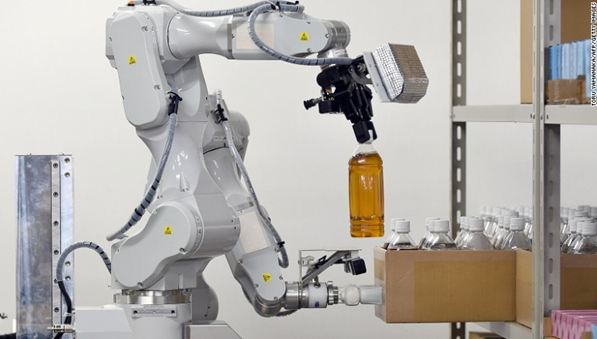
A computer relies on serial algorithm (step by step procedure to do something) based processing, controlled by a CPU and store the information at a particular location in the memory. On the other hand, the human brain processes information in parallel, distribute control through billions of highly interconnected neurons or nerve cells (processing unit) and store information in various straight connections. AI is the way of making a computer think intelligently similar to how humans think.
Machine Learning (ML) is a part of AI. ML is getting computers to program themselves. If programming is automation, then ML is automating the process of automation. The processes that are described in this article also apply to ML.
Artificial Neural Networks (ANN)
When we see a cow how do we know it’s a cow? It’s because our brain tells us that the creature is a cow. The first time we had seen a cow in our childhood perhaps our parents had told us that it was a cow. Our brain instantly recorded the features of a cow- tail, colour, shape, size, etc. Sometime later when we had seen a buffalo and we told it as a cow our parents might have corrected us and told that it is a buffalo. Instantly the brain recorded the unique features of a buffalo. When we type Sachin Tendulakar in Google, we get to so many pictures of Tendulkar from so many websites among so many pictures of other persons and things.
For example, a large number of pictures of different breeds of dogs are fed into a ANN. Then the software is trained by humans to recognize different breeds of dogs by defining colour, body structure, size, etc. Now if we give the photo of German Shepherd whose exact image may not be there in its memory, even then the software will give the output as it. Artificial Neural Network (ANN) also called Deep Learning is an information processing model that is inspired by our biological nervous system. ANNs are mainly used for simulation. We play rail simulator games, even pilots are trained in a cockpit simulator. We like simulator games when it’s realistic as much as possible. Simulations play a crucial role in engineering, medical science, weather forecasting and economics. Just like those games, simulations are more useful when it can replicate real life situations as exactly as possible.
What is Simulation? Simulations can answer ‘what if condition’ and are used for the evaluation of the performance of a system and predicting future events. They are used mostly along with optimization.
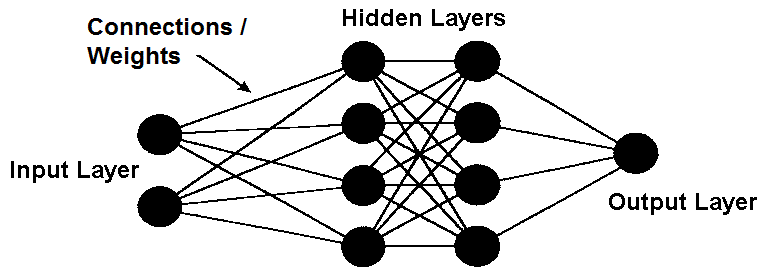
ANN’s ability to learn so quickly is what makes them so useful. But how do they learn? Information flows through a neural network in two different ways. When the model is learning (being trained) or operating normally (after being trained either being used or tested), patterns of information from the dataset are being fed into the network via the input neurons, which trigger the layers of hidden neurons, and these in turn arrive at the output neurons. This is called a feedforward network. Not all neurons “fire” all the time. Each neuron receives inputs from the neurons to its left, and the inputs are multiplied by the weights of the connections they travel along. Every neuron adds up all the inputs it receives in this way and (this is the simplest neural network) if the sum is more than a certain threshold value, the neuron “fires” and triggers the neurons it’s connected to (the neurons on its right).
For an ANN to learn it has to learn what it has done wrong and is doing right, this is called feedback. Feedback is how we learn what is wrong and right and this is also what an ANN needs for it to learn. If we are learning to play football we will learn that if we kick the ball too hard near the net it will fly over the net, or if we don’t kick it hard enough it would slow down before reaching the net and we miss a goal. We may also learn as we continue playing which is the best angle to kick the ball. This how our brain learns and this is how an ANN needs to learn. Neural networks learn things in exactly the same way as the brain, typically by a feedback process called back-propagation.
Verification is an important step in designing ANNs. For example, the meteorological department designs an ANN to predict the amount of rainfall in India. ANN will take input data of low and high pressure zones, their intensity, direction and speed of winds, etc. Its output will be the amount of rainfall and a complex ANN may also include the distribution pattern. After designing the ANN, scientists will first verify it by giving input data of previous years 2018, 2017, etc. If the ANN cannot predict the rainfall (approximately) of 2018, 2015 they will modify it until it can do so. Only then the ANN will be used for predicting rainfall for 2019, 2020….. ANN’s ability to combine both real-time data and historical data gives them superiority over conventional statistical and mathematical methods. As things like rainfall, traffic in roads, stock market conditions, diseases are determined both by prevailing conditions and historical patterns.

What are neurons? An artificial neuron is a mathematical function conceived as a model of biological neurons. Artificial neurons are elementary units in an artificial neural network. The artificial neuron receives one or more inputs (representing dendrites) and sums them to produce an output.
The following 2 are the most commonly used ways by which ANNs learn-
Supervised Learning: Supervised Learning is where the data from the dataset is labelled. The training data consist of pre-set training examples. For e.g. we label the pictures of different breeds of dogs and train an ANN to recognize breed of a dog even its memory does not contain the picture of that dog.
Unsupervised Learning: It is used to draw inferences from datasets consisting of input data without labelled responses. This is where we can do a lot of amazing research because there is so much unlabelled data in the world and if we make sense of it, there is a lot of uses. We can understand it better after knowing nicely about supervised learning.
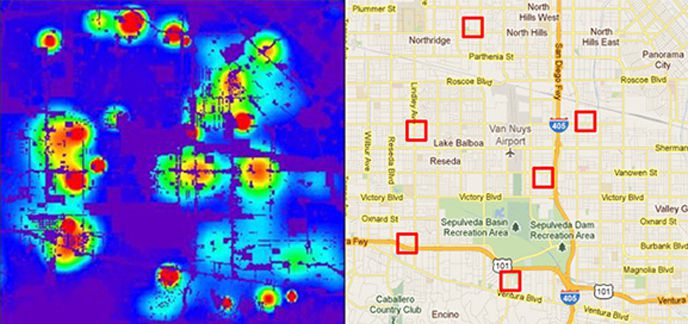
Security systems use ANN. For example, an alarm will ring if the CCTV camera spots a person who jumps over our boundary wall at night, but not if a cat tries to do so( Character Recognition). Google Maps relies on ANN for giving us the route to save time. The ANN considers both the present traffic and also the traffic patterns of previous days as cars and buses varies by time of the day, festivals. Then it shows us the route.
Evolutionary Algorithms (EA)
We often use Google maps to get the shortest route between 2 places. This is an example of optimization by which we can save time and fuel to travel. We think which will be the best watch to buy based on its colour, quality, brand, size as per our needs. Even this is optimization.
What is Optimization? Optimization is the mathematical discipline of obtaining the best result under given circumstances.
Suppose a train engine is given 80 litres of diesel to reach Delhi from Guwahati and is given a target to earn Rs. 60,000. How should the train optimally travel to reach Delhi with 80 litres of dieses and earn Rs. 60,000. A train of 22 bogies will not be full by only people going from Delhi to Guwahati. So the first idea to stop at multiple cities on the way to earn Rs.60,000. But more stops will mean more fuel consumption as it takes greater fuel to start an engine from 0 km/hr but the engine has only 80 litres. So we have to find out the optimum number of stops (cities where more people are likely to travel from Guwahati and to Delhi), in such a way that the train can reach Delhi with 80 litres of diesel. This is a simple example of optimization problem.
Darwin’s theory of natural selection proposes that the plants, animals and almost every living organism that exists on this planet today is the result of millions of years of adaption to the demands of highly complex and dynamic environments. Evolutionary Algorithms (EA) mimics natural evolutionary principles to search for an optimal solution to a problem.
In any optimization problem, a number of possible solutions to a problem are available and the task is to find the best solution in a finite amount of time. For a search space with only small number of possible solutions, all the solutions can be examined in reasonable amount of time and the optimal one can be found. This exhaustive search, however, quickly becomes impractical as the search space grows in size. This is where EA comes into picture. The genes of organisms tend to evolve over successive generations to better adapt to the environment as the best adapted organisms are selected by nature to pass on their characteristics to the next generation.
In EA, we have a population. In population, we have set of individuals and each individual in the population is a possible solution for the given problem. We call these individuals as chromosomes. Each chromosome is made up of genes. What are genes? These are the parameters of the given optimization problem.
Algorithm is started with a set of solutions (represented by chromosomes) called population. Solutions from one population are taken and used to form a new population. This is motivated by a hope, that the new population will be better than the old one. Solutions which are selected to form new solutions (offspring) are selected according to their fitness – the more suitable they are the more chances they have to reproduce. This is repeated until some condition (for example number of populations or improvement of the best solution) is satisfied.
Fuzzy Logic
The conventional Boolean logic block that a computer can understand takes precise input and produces a definite output as TRUE (1) or FALSE (0), which is equivalent to human’s YES or NO. Fuzzy logic is a generalization of standard logic, in which a concept can possess a degree of truth anywhere between 0 and 1.Fuzzy logic is supposed to be used for reasoning about inherently vague concepts, such as ‘liveable’. For example we might say Zurich is the best liveable city in the world with a degree of truthfulness 0.7. It is an optimization method which uses the Set Theory.
The latest washing machines come with a fuzzy mode which attracts a lot of people. These washing machines have a Fuzzy Controller which checks for the cloth material, extent of dirt and grease, the amount of soap and water to add, direction of spin, and so on with the help of sensors. It then regulates the water intake, water temperature, wash time, rinse performance, and spin speed. More sophisticated machines even tell us the amount of detergent to be put. Over time the machine learn from past experience, memorizing programs and adjusting them to minimize running costs.
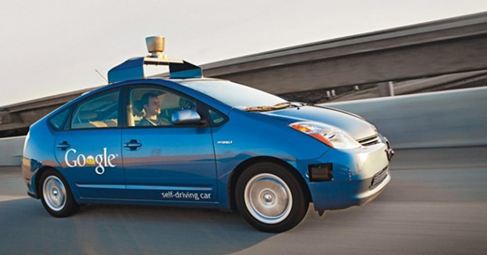
We are familiar with AI being used in self driving cars, autonomous trains, robots in factories or the latest Sophia robot and Amazon’s Alexa. Some of the interesting applications of AI include detection of unidentified pollutants in an aquifer, optimising reservoir operations, surface run-off modelling, designing compact layouts of buildings, efficient extraction of petroleum, enhancing antibiotic production, medical diagnosis, optimizing chemotherapy and radiation for cancer treatment.

AI is a multidisciplinary field involving computer science, information technology, electronics, physics, material science, mathematics, psychology and biology (especially neuroscience and genetics). Along with the development in computing power and data analytics, continuous research in biology is essential to make AI more advanced. The more we know about our brain and evolutionary processes, the more advanced AI becomes. Also specific applications need specific expertise. For example, to use AI in watershed management hydrologists are needed. According to me the involvement of biologists in applying AI in engineering can lead to better systems.
As was in the case of Information Technology that when more people gained access to it, the society got so many benefits from paying our electricity bills to calling a taxi at the touch of our fingers. Therefore it is essential that scientist create systems through which more people can make use of AI to spur innovations.
( The author is a Member of the World Conference on Transport Research Society and an Innovator under National Innovation Foundation-Department of Science & Technology, Government of India)

 Citta
Citta 